Concrete Permits in the East Bay: What Needs One, City by City
Your backyard patio usually needs no building permit. The sidewalk out front always needs one. Here’s the permit map for concrete work in Richmond, Berkeley, Oakland, and along the 680 corridor — drawn from each city’s own rules.
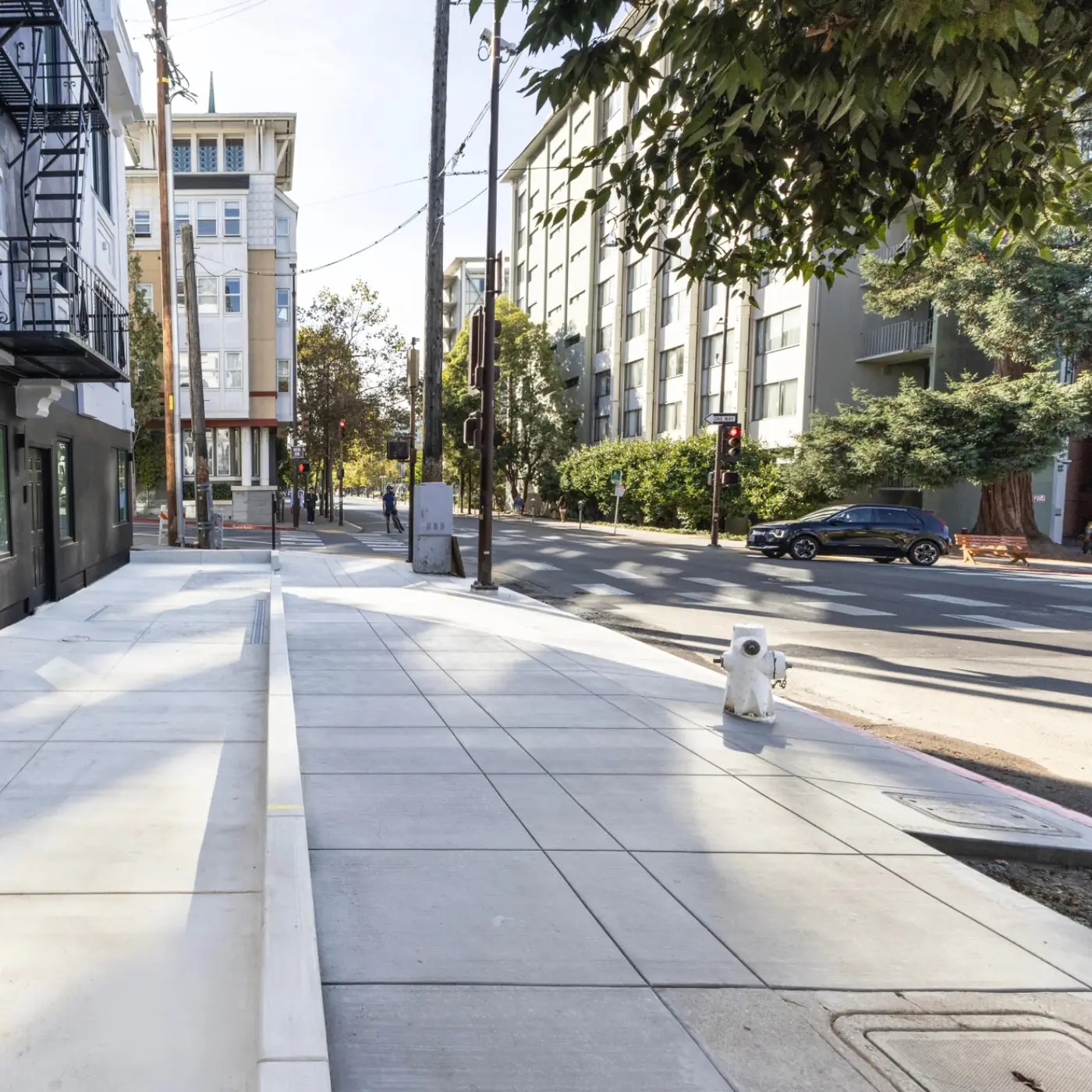
“Do I need a permit for this?” is the question we hear most after price — and the honest answer is “it depends on which side of the sidewalk it’s on, and which city you’re standing in.” Concrete work actually runs through two separate permission systems: a building permit for what happens on your property, and an encroachment permit for anything that touches the public right-of-way. Cities layer their own amendments on top of both.
This is the plain-English map. Everything below comes from the cities’ and counties’ own published rules (all linked at the bottom), checked in August 2026 — but codes get amended and counters interpret, so treat this as orientation, not gospel. A ten-minute call to your permit counter settles any edge case. Or let your contractor carry it: pulling the right permits is part of the job, not a favor.
The statewide baseline: what never needs a building permit
Every California city starts from the state building code’s “work exempt from permit” list, then amends it locally. Under the state baseline, these need no building permit:
- At-grade flatwork on your own property — patios, walkways, and driveways “not more than 30 inches above adjacent grade,” in the code’s words. A normal backyard patio or a driveway on your side of the sidewalk qualifies.
- Retaining walls up to 4 feet tall, measured from the bottom of the footing to the top of the wall — unless the wall supports a surcharge, meaning a slope, driveway, structure, or anything else pushing on it from above. A surcharge voids the exemption at any height.
- One-story detached accessory structures of 120 square feet or less — the classic shed-pad scenario.
Two catches before you relax. First, a building-permit exemption doesn’t override anything else — zoning setbacks, creek ordinances, stormwater thresholds, and the right-of-way rules below all still apply, and the code says so explicitly. Second, cities amend the list: unincorporated Contra Costa County, for example, tightened the retaining-wall exemption from the state’s 4 feet down to 3. That’s why the city-by-city section of this post exists.
The sidewalk out front is not yours to pour
The most common surprise in East Bay concrete: the sidewalk, curb, gutter, and the driveway apron between the sidewalk and street sit in the public right-of-way — and every jurisdiction here requires an encroachment or engineering permit, plus inspection, for any work on them. There are no exceptions among the cities we work in. New or widened curb cuts get extra scrutiny everywhere.
The second surprise: California law makes the fronting property owner responsible for maintaining that sidewalk anyway. You don’t own it, you can’t pour it without a permit — but if it heaves and someone trips, the liability points at you. That combination (owner responsibility + mandatory permits + city inspection) is why sidewalk work is its own discipline, and why bids that skip the permit aren’t really cheaper.
The stormwater threshold: 2,500 square feet
The whole Bay Area sits under a regional stormwater permit that cities must enforce through their planning and building counters. For a single-family property, the number to know is 2,500: create or replace 2,500 square feet or more of impervious surface — roof and pavement combined, over the whole project — and the city must require at least one “site design measure.” Permeable paving is one way to satisfy it, but so is simply directing the runoff onto your own landscaping; it’s a menu, not a permeable-pavers mandate.
Cross 10,000 square feet on a single-family project (ADU projects included), or 5,000 on most other project types, and you’re into full stormwater-treatment territory — engineered plans, sized treatment measures, maintenance agreements. Most driveways and patios never get near either line, but a large hillside rebuild with new roof, driveway, and flatwork can — and it’s the whole project that counts, not each surface separately.
Richmond
Our home city runs the state playbook straight. The Building Division publishes the state exemption list as-is: at-grade flatwork on private property is exempt from building permits, retaining walls follow the 4-foot-from-bottom-of-footing rule, and foundation work is always permitted work. The right-of-way side is equally clean: any work on the sidewalk, driveway approach, or curb and gutter requires an encroachment permit through the Engineering Division — a separate submittal from any building permit, both handled through the city’s online portal.
Berkeley
Berkeley follows the state exemption list for private-property flatwork, and routes all right-of-way concrete — sidewalk, curb, gutter, driveway approach — through an Engineering Permit from Public Works, built to the city’s published concrete specifications. Berkeley is also unusually explicit that sidewalk maintenance belongs to the property owner, and unusually helpful about it: the 50-50 program lets you ask the city to do the repair and bill you half, and if a city street tree did the damage, the city covers its half.
Berkeley’s quirks are geographic. No new building within 30 feet of an open creek’s centerline; work within 15 feet of a culverted creek needs its own permit from Public Works. Hillside fire zones carry construction requirements, projects moving more than 50 cubic yards of soil need a grading plan, and a retaining wall inside a required setback needs a zoning permit even when it’s short enough to skip the building permit.
Oakland
Oakland has the most elaborate system in the East Bay, and it helps to know which permit is which. Private-property flatwork at grade is exempt from building permits (zoning can still apply). Right-of-way concrete runs on a CGS permit — curb, gutter, sidewalk — from the Department of Transportation, and a licensed contractor must be the one to pull it. Installing, widening, or removing a driveway needs zoning approval before DOT sees it, and residential curb cuts are capped in width. Sidewalk repairs over 25 square feet need the permit, the city enforces repairs with 30-day notices, and — unique in the area — sidewalk repairs must be completed when a property changes hands or gets a major renovation.
Beyond that: concrete or masonry walls over 3 feet need a building permit even as plain fences (wood gets 7 feet), retaining walls need structural calculations and design review if visible from the street, and foundation repair or replacement takes planning review plus a building permit. Creekside properties need a Creek Protection Permit for almost any work near the bank — patios included. Hillside grading over 50 cubic yards needs a grading permit, and none of it happens between October 15 and April 15: Oakland runs a wet-season grading moratorium, which is a real scheduling constraint on hillside foundation work.
Lamorinda, the 680 corridor, and unincorporated Contra Costa
Walnut Creek says it in plain English: “Concrete flatwork on private property does not require a permit.” Replace the approach or sidewalk out front and you’re back to an encroachment permit. Retaining walls trigger a building permit over 4 feet from the footing, over 3 feet of retained soil, or with any surcharge — and a separate site-development permit can apply at 3 feet above grade or 50 cubic yards of grading.
Danville is stricter on paper than its neighbors: the town’s own FAQ lists patios among permit-required accessory structures, and its retaining-wall permit kicks in at just 3 feet of retained soil or any surcharge at all. Hillside lots face grading permits at 100 cubic yards and geotechnical reports in hillside areas. If you’re pouring in Danville, make the call first.
Lafayette, Moraga, and Orinda contract their building permits out to Contra Costa County — applications go through the county in Martinez even though planning review and encroachment permits stay with each city. And unincorporated communities — Alamo, El Sobrante, Kensington — are county territory entirely: county building permits, county encroachment permits, and the county’s stricter retaining-wall rule, which exempts only walls up to 3 feet measured from the top of the footing. The county also closes a popular loophole in writing: a concrete or masonry wall is a wall, not a fence, and needs a permit regardless of what it’s called.
Foundations and anything structural: always a permit
No East Bay jurisdiction exempts foundation work — new foundations, replacements, or structural repairs are permitted, engineered, and inspected everywhere, with pre-pour inspections built into the schedule. Oakland says it outright; everywhere else it follows from foundations never appearing on an exemption list. The same logic covers engineered retaining walls: past the 3-or-4-foot threshold, or with any surcharge, you’re in permit-and-engineer territory in every city — and given what East Bay soil does to structures, that’s the right side of the line to be on.
The practical summary: a patio or walkway in your yard usually needs no building permit anywhere in the East Bay. The moment work touches the sidewalk, curb, or apron, it needs a city permit — every city, every time. And walls, foundations, and hillside work need permits and usually an engineer. A licensed contractor should carry all of this for you: we pull the permits, build to the city’s standard drawings, and schedule the inspections as part of every scoped job — it’s built into our free, itemized estimates, and it’s part of why Bay Area bids price the way they do.
Common questions
Do I need a permit to pour a patio or walkway in my backyard?
Usually no building permit — at-grade flatwork on private property is exempt under the state code baseline that East Bay cities start from. The exceptions are worth checking: Danville lists patios as permit-required, Oakland requires a Creek Protection Permit near creeks, and projects creating or replacing 2,500+ sq ft of hard surface trigger stormwater measures. One call to your permit counter settles it — or we flag it during the estimate.
Do I need a permit to replace my driveway?
The part on your property: generally no building permit. The apron between the sidewalk and the street: yes — that’s public right-of-way, and every East Bay city requires an encroachment permit and inspection there. A new or widened curb cut adds zoning review in Oakland and extra scrutiny everywhere. Our driveway page covers how we scope that split.
When does a retaining wall need a permit?
At 4 feet measured from the bottom of the footing in Richmond, Berkeley, Oakland, and Walnut Creek — the state threshold. Unincorporated Contra Costa County (including Alamo, El Sobrante, and Kensington) and the Lafayette-Moraga-Orinda area use a stricter 3-foot rule, and Danville triggers at 3 feet of retained soil. In every jurisdiction, a surcharge — a slope, driveway, or structure bearing on the wall — requires a permit at any height, and the code requires an engineered design past 48 inches of unbalanced fill — see why retaining walls fail for what those thresholds are protecting against.
Who pulls the permit — me or the contractor?
Normally the contractor, and in some cases it must be: Oakland only issues its curb-gutter-sidewalk permit to a licensed contractor. Having the contractor pull the permit also keeps responsibility where it belongs — the license on the permit is the one accountable for the inspection. Ours is CSLB #1020281, checkable in a minute at cslb.ca.gov.
What happens if I skip a permit?
Right-of-way work can be red-tagged and redone at your expense, and unpermitted work surfaces at the worst time: Oakland requires sidewalk repairs completed when a property changes hands, and unpermitted structural work shows up in inspections and disclosures when you sell or refinance. The permit is a fraction of the cost of doing the job twice.
Sources & further reading
- California Residential Code — §R105.2, Work Exempt From Permit (2025)
- City of Richmond — Engineering Permits & Requests
- City of Richmond — Work Exempt from Permits
- City of Berkeley — Work Exempt from Building Permits
- City of Berkeley — Engineering Permits
- City of Berkeley — Sidewalk Repair & the 50-50 Program
- City of Oakland — Work Exempt from a Building Permit
- City of Oakland — Sidewalk Permits & Certification (CGS)
- City of Oakland — Creek Protection Permits
- Contra Costa County — Work Not Requiring a Building Permit
- Contra Costa County — Retaining Wall Requirements
- City of Walnut Creek — Building Permit FAQs
- Town of Danville — Encroachment Permits
- SF Bay Regional Water Quality Control Board — Municipal Regional Stormwater Permit (Order R2-2022-0018)
Planning a concrete project?
We offer free estimates across the San Francisco Bay Area. Tell us what you’re working on and we’ll walk the site with you.
Request an estimate